Gunta Stolzl
Create:
Make your own backstrap loom out of simple popsicle sticks - this is far easier than it looks, and the quality of weaving that you can get is much higher than the simple cardboard looms that we used this week. Try it out!
Watch:
Modern artists still create woven tapestries. The technique is quite different from typical weaving, but fascinating. Check it out. This is something you could try on your small loom if you'd like.
Learn more:
Kandinsky and Klee were also members of the Bauhaus. Check out our previous lessons & projects on these masters
What is the difference between arts and crafts? Watch this Ted talk to help discern the difference.
Consider:
The Bauhaus movement attempted to bring together the disparate fields of industrial technology and craftsmanship, beauty and function, theories and practice. This wasn't always easy. Our ever-changing world often makes us feel as if there are more questions than answers. Check out http://findithere.com/answers.php for hope.
Sheryl

Showing posts with label Project Ideas. Show all posts
Showing posts with label Project Ideas. Show all posts
Sunday, October 30, 2016
Monday, November 30, 2015
Mary Azarian lesson extension activities
The snowflake prints that you made are stunning! Great job!

Mary Azarian’s beautiful painted woodcut prints highlight life in rural Vermont. Her folk-art is featured in more than 50 books, and earned her the Caldecott medal in 1999 for her work illustrating “Snowflake Bentley.”
Visit the artist’s own site


Complete project instructions available at libertyhillhouse.com
Mary Azarian’s beautiful painted woodcut prints highlight life in rural Vermont. Her folk-art is featured in more than 50 books, and earned her the Caldecott medal in 1999 for her work illustrating “Snowflake Bentley.”
Read:
There are many books illustrated by Mary Azarian that you can borrow from your local library. Here are a few of my favorites:


Watch:
Watch a video of Mary Azarian describing her work on Snowflake Bentley & other woodcuts:Learn:
Read about Mary Azarian’s print making processVisit the artist’s own site
Create:
Now that you've made your own print block, you can print it as many times as you would like. Turn it into a tee-shirt with these simple directions.

Saturday, January 24, 2015
Franz Marc lesson extension activities
It is interesting to think about what Franz Marc might have painted if he had lived through World War 1. More nature? More "flaming agony?"

Explore:
- Deep meaning is the key hallmark of expressionism. Enjoy stretching your own ability to consider beyond the obvious. Read familiar fables at aesopfable.com. What is the author trying to convey? Next, try to match one of Franz Marc’s paintings (available at Guggenheim.org) to the tale.
Consider:
- Marc was taught about Jesus by his mother, but later decided that only animals are worthy of living in paradise. Do you agree? Read John 3:16. Consider the word "believe" in this verse. What is the one requirement for salvation? Can animals believe? Is this promise for all creatures on earth? (Parents - Please be intentional in patiently listening to your child's reasoning for their answers. This is a large concept to grasp, and they may have pets that they are concerned about.)
Read:
The Blue Rider: The Yellow Cow Sees the World in Blue

Monday, October 27, 2014
Giotto Extension Activities
 Giotto di Bondone’s fame grew throughout his life, attracting the attention and friendship of not only popes but also kings. In 1334, three years before his death, the city of Florence appointed him chief of public works. He was in the middle of building the Campanile (‘Giotto’s Bell Tower’) at the time of his death.
He passed away wealthy, famous, and successful.
Read:
- A Boy Named Giotto by Paolo Guarnieri
- Giotto by Mike Venezia
 Observe:
- Watch a slideshow of Giotto’s work
- Enjoy a short video biography of Giotto
Create:
Now that you have your own acrylic paints, it is time to figure out all that they can do. Spread out the newspaper sometime this week and try a few of the ideas at TinyRottenPeanuts. Which technique is your favorite?
Consider:
In Giotto's time it wasn't unusual for an artist paint all of their most famous work in churches. Times have changed, but the fact that we find Giotto's frescoes only in places of worship. gives us something to consider today. In 1Cor. 10:31 we learn,
“So whether you eat or drink or whatever you do, do it all for the glory of God.“
What do you think that means? What do Biblical scholars think?
Did you miss this month's lesson? Find the complete instructions for our project at LibertyHillHouse.com
Saturday, September 27, 2014
Andy Warhol Extension Activities

Born in PA, Andrew Warhola was the first star of pop art. Fantastic at marketing himself, he changed his name to Andy Warhol and became one of the greatest artistic businessmen.
Warhol moved to NYC in 1949, where he got a BA in graphic design and worked as an illustrator for magazines for more than 10 years. Despite his commercial training, Andy saw himself as a “pure” artist.
Not content to be just a great commercial artist, Warhol appropriated imagery from consumer culture and changed all of the boundaries that had existed between fine art and the more familiar imagery found in advertising.
He invented blotted line technique, which he used to create whimsical illustrations. The process was tedious, and often included multiple apprentices. First he drew an image on waterproof paper with a pencil. Then it was traced with ink. The paper was then flipped and pressed on absorbent paper. The printed image was finally colored in using pastels.
Read:
- As always, Mike Venezia's introductory art books are at the top of my list. The one on Andy Warhol is no different. Fantastic from beginning to end.
- Written by Andy Warhol's nephew, "Uncle Andy's" offers a fun and unique perspective on the artist.


Explore Online:
- Queensland Art Gallery has a fun interactive site devoted to Andy Warhol' life. Have fun learning what Andy was like as a boy!
- The Warhol Museum has a fantastic gallery of online images. You might be surprised to see how diverse his interests were. Take a look.
Create:
- Did you know that Andy Warhol collected cats? He had over 25! Try making your own version of his "Red Sam" with these instructions.
- Make your own image into pop art using this online converter. I already have the settings ready for you, just scroll down to step 3 and upload your photograph! Don't worry about the mention of facebook, the image will not show up in your feed unless you approve it at the very end.
- Andy Warhol once said, “Art is what you can get away with.” - What do you think he meant? Do you agree?
Join Us:
Remember to to put Sunday October 5th on your calendar. We are going to all meet up to pick apples for a neighbor. Join us at 3:30 at http://www.macksapples.com in front of main stand.
Sunday, May 11, 2014
Rembrandt Lesson Extension Activities
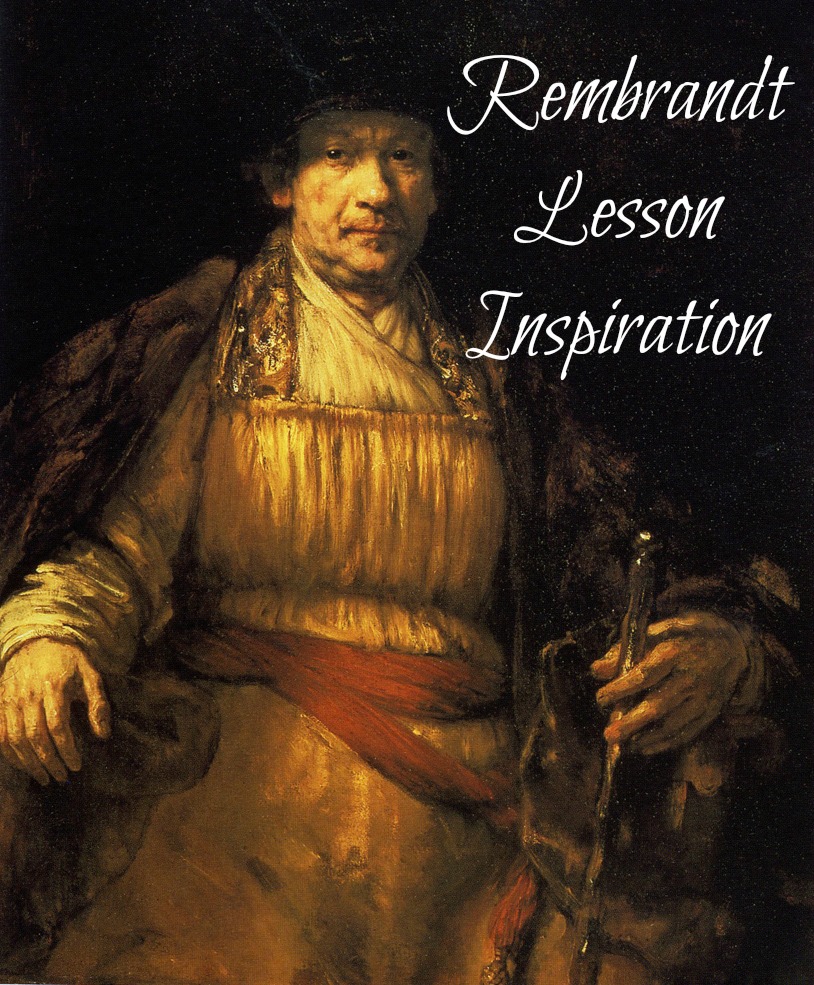 |
Self Portrait
Rembrandt van Rijn
1658
Oil on Canvas
Frick Collection, NYC
|
Read:

- We really enjoyed reading Hana in the Time of the Tulips* by Deborah Noyes. I believe it is out of print now, but check your local library to see if they have a copy available.
- Rembrandt and the Boy who Drew Dogs* by Molly Blaisdel was also fun.
- Rembrandt* by Xavier Niz, while not as entertaining, was very informative.
Online Activities:
- Want to see more of Rembrandt's work? There is a fantastic listing of Biblical artwork by Rembrandt available at ArtBible.info Take a look! How many stories can you recognize?
- See Rembrandt age through his own self portraits in this short video.
Create:
- Color an image of Rembrandt (okay, so the cartoon version of Rembrandt) in his studio at Getting to Know.com. Their videos are fantastic by the way, I highly suggest you take a look.

Consider:

 *Items marked with an asterisk are affiliate links. I only list items that my family uses and enjoys, but you should be aware that, should you click through, I may receive a portion of any purchase that you make on the linked site. There is no cost to you.
Wednesday, February 26, 2014
Eric Carle Lesson Extension Activities
The felt board that you made for the Bedford library is going to be so much fun for the kids to play with. Thanks for your hard work!
 Complete project instructions available here.
Read:
The felt board that you made for the Bedford library is going to be so much fun for the kids to play with. Thanks for your hard work!

Complete project instructions available here.

 “With many of my books I attempt to bridge the gap between the home and school. To me home represents, or should represent; warmth, security, toys, holding hands, being held. School is a strange and new place for a child. Will it be a happy place? There are new people, a teacher, classmates—will they be friendly?"
There are lots of books that we can look at to see Eric Carle's artwork, but I wanted to point out a few that offer more insight into his life. Eric Carle has written a fantastic series of autobiographical stories in two books entitled Flora and Tiger and My Apron. They are written directly to children in a way that is both playful and informative. I can’t say enough how much my family enjoyed these books. {These books are affiliate links. Should you click through I may get a small portion of any purchases that you make. Thanks for your support.}
Create:
Coloring pages are always fun, but if you want a bit more of a challenge, try creating your own tissue paper collage. This PDF offers instructions that are fairly easy to follow.
Create:
Coloring pages are always fun, but if you want a bit more of a challenge, try creating your own tissue paper collage. This PDF offers instructions that are fairly easy to follow.
Visit:
Eric Carle and his wife have created a fantastic museum dedicated to illustrators of children’s books. It is a lot of fun! Even if you can’t get there in person, it is more than worthwhile to take a look at their website.
Consider:
Want to find out how Very Hungry Caterpillar, the Bible, and throw-up all tie together? Pop by the Fantastic Five to find out.
Saturday, December 28, 2013
Cezanne Gift Boxes
I hope you all found the perfect recipients for your Cezanne inspired pastel gift boxes! 
Friday, December 27, 2013
Cezanne Extension Activities
Have you ever doubted yourself? Paul Cezanne struggled with many uncertainties throughout his life. He endured the skepticism of his family along with multiple failures. He wasn't a spectacular art student, and he was unsure whether his passion was correctly placed. Despite these hardships, he persevered in creating the art that he loved using simple geometric forms.
Perseverance is one of the greatest things you could ever learn.
 Meeting Cezanne by Michael Morpurgo is a charming book that explores Cezanne's famous Franch landscape. It also touches on the relationship between Picasso and Cezanne. It is short but very nicely done.
  {affiliate link}
So, what do you think? Does his perspective and work fit what you would expect from "The Father of Modern Art?"
Perseverance is one of the greatest things you could ever learn.
Online activities
The Metropolitan Museum of Art has created a fantastic resource. Take a look at Cezanne's Astonishing Apples, and don't miss the story "An Apple a Day" on the very last tab!
Read
Meeting Cezanne by Michael Morpurgo is a charming book that explores Cezanne's famous Franch landscape. It also touches on the relationship between Picasso and Cezanne. It is short but very nicely done. {affiliate link}Create
ArtforSmallHands has a very simple tutorial on painting Cezanne inspired still-lifes that my kids really enjoyed. Or give it a try using your pastels and the ideas on PinkAndGreen.Consider
“For I am the Lord, your God,
who takes hold of your right hand and says to you,
Do not fear; I will help you.”
(Isaiah 41:13)
Sadly, Cezanne is known to have said, “life is terrifying.” He used the act of painting to sooth himself, painting while police looked for him for dodging the draft, and even on day that mother died. He suffered with a dark depression, and kept himself fairly isolated.
Everyone feels afraid at some time, but it must be awful to feel that life is terrifying.
who takes hold of your right hand and says to you,
Do not fear; I will help you.”
(Isaiah 41:13)
So, what do you think? Does his perspective and work fit what you would expect from "The Father of Modern Art?"
Saturday, November 9, 2013
Chihuly Extension Activities
Do you see now why Dale Chihuly is considered by many to be the greatest living glass artist? His amazing works have completely transformed the art-glass movement into larger than life experience including towering sculptures, floating spheres, and intricate details.


Of course we all still sin, but people who live in the light of Jesus, studying the Bible and praying to Him, have God's help to change their bad habits. They hate the darkness and love the light of Jesus.

I can't wait to show you how amazing your projects look when I finally get them all strung together for the Christmas display. Update coming soon!
Watch:
- Take a look at this video of Chihuly and his team creating one of the glass pieces for his sculptures - pay close attention to how difficult this would be for any one artist to do on their own.
Read:
- The Children's Museum of Indianapolis funded the creation of this fantastic Printable Book. Keep an eye out for the great unit study ideas for grades 3-5.
- Curious about how his pieces are designed and installed? Houzz has a fantastic step-by-step collection of photos and instructions.
Create:


- Now that you know how to use your shrink film to create unique shapes, you can begin designing you own creations. How about making icicles for your Christmas tree or necklace pendants?
Consider:
We learned a lot about light during our study of Chihuly's work. Have you ever read John 3:19-21? It says this:
Light has come into the world, but people loved darkness instead of light because their deeds were evil. 20 Everyone who does evil hates the light, and will not come into the light for fear that their deeds will be exposed. 21 But whoever lives by the truth comes into the light, so that it may be seen plainly that what they have done has been done in the sight of God.So why does the Bible have verses about light? Well, that light is Jesus. We can't see anything in the dark of sin, but when we follow Jesus we walk in the light we are able to see and we can stay far away from the areas that are dark with sin.
Of course we all still sin, but people who live in the light of Jesus, studying the Bible and praying to Him, have God's help to change their bad habits. They hate the darkness and love the light of Jesus.

I can't wait to show you how amazing your projects look when I finally get them all strung together for the Christmas display. Update coming soon!
Saturday, October 19, 2013
Toulouse-Lautrec Extension Activities
Henri de Toulouse-Lautrec was only a little over four and a half feet tall at maturity, but his impact on the world of art was larger than life.
Read:
 I hope you will have time to take a look at my absolute favorite book about this artist: Great Names: Toulouse-Lautrec 19th Century French Painter by Diane Cook. {affiliate link} It has wonderful illustrations, accurate history, and handles delicate topics in a respectful yet factual way.
Create:
- Practice drawing faces with proportion grids online. Scroll down to view all of the instructions.
- Try using your water paints to complete this coloring page of Toulouse-Lautrec's painting. Don't forget to use eye-catching colors!
- Do another copy with marker, and a third with crayons. Compare the results. Which looks most like the original oil painting?
 |
| Marcelle Lender doing the Bolero in 'Chilperic' 1895 Private Collection{{PD-Art}} |
Consider:
Henri de Toulouse-Lautrec died at a very young age because of the poor choices that he made.The Bible says a lot about keeping ourselves healthy. Many people may respond "Who cares? It's my body, isn't it?" Well, to be honest, the answer from the Lord is a resounding, "I care, and no, it really isn't your body to begin with. I created you, I died for you, and I love you even more than you love yourself."
Here is the direct quote from 1 Corinthians 6:19-20
"Do you not know that your bodies are temples of the Holy Spirit, who is in you, whom you have received from God? You are not your own; you were bought at a price. Therefore honor God with your bodies."
We all make mistakes. Encourage your child to discuss the many ways that life can be hard. Remind them that Jesus said, “I have overcome the world.” He can help where alcohol and other indulgences cannot. He does not always make our problems go away, but He has promised to help us.
If you have any questions feel free to get in touch with me or call New Hope at 345-7203.
Sunday, September 22, 2013
Grant Wood Extension Activities
Isn't it interesting how Grant Wood combined fanciful and realistic elements in the same painting? I just love his sense of whimsy.
Ready to learn more? Here are some more activities to try:
Texture is one of the most important art elements in Grant Wood's work. It is what gives his artwork depth and what makes it look real (or distinctly not-real). Remember those texture rubbings we did on our Grant Wood landscapes? Here's a way to learn how to create the same texture using your pencils.

Ready to learn more? Here are some more activities to try:
 Create
Texture is one of the most important art elements in Grant Wood's work. It is what gives his artwork depth and what makes it look real (or distinctly not-real). Remember those texture rubbings we did on our Grant Wood landscapes? Here's a way to learn how to create the same texture using your pencils.
- Use your pencil to create a texture rubbing using the bottom of your shoes, a drinking glasses, or leaves.
- Then, using the same pencil, try to duplicate the look of that rubbing. Pay close attention to how dark or light the marks are. (hint: use the side of your pencil rather than the point)
- For more detailed instructions on how to create this project take a look at TeachKidsArt

Look
Grant Wood is most famous for American Gothic, but he has done much more.- Museum Syndicate has a great digital collection of his work. Take some time and flip through. Which one is your favorite?
Watch
- Kahn Academy (one of my all-time favorite free resources) has a wonderful video discussing Wood's American Gothic. It might be a bit much for younger students, but it is truly fascinating.
- The video Dropping in on Grant Wood {affiliate link} is an adorable cartoon that does a great job of telling the story of Grant Wood's life. Check to see if it is available in your local library. There is also a companion book that is quite good.
Go
The Boston Museum of Fine Arts is offering FREE ADMISSION on October 14th. This would be a great opportunity to take a look at some of Grant Wood's pieces in person. They also have a fantastic exhibition opening soon on American abstract expressionism that I think the kids would enjoy (in addition to the always popular mummies).
Consider
Grant Wood was raised in a Quaker home.- Learn more about what the Quaker's believe at HistoryforKids. Does this sound similar to what you believe? What is different?
- In official Quakerism, few believe in the need for salvation. This is because most Quakers don't accept the reality of sin. Instead they focus on improving themselves through good works and acting peacefully. Is it possible to please God by simply doing good things?
Sunday, June 2, 2013
Seurat Extension Activities
 Looking for more Seurat information? Try this:
Read
 Seurat and La Grande Jatte: Connecting the Dots
Look
A Sunday on La Grande Jatte shows a large cross section of Parisian life in Seurat's time. Can you find...Steamers? sailing boats? a rowing boat?
People taking a walk? fishing? sitting?
Young girls? a nanny? an elderly grandmother?
a pug? a butterfly? a monkey?
two soldiers? a red haired child? a baby?

Understand
Great description of the science behind why pointillism works - http://vimeo.com/28491307Create
A Sunday Afternoon inspired coloring page
Subscribe to:
Posts (Atom)